
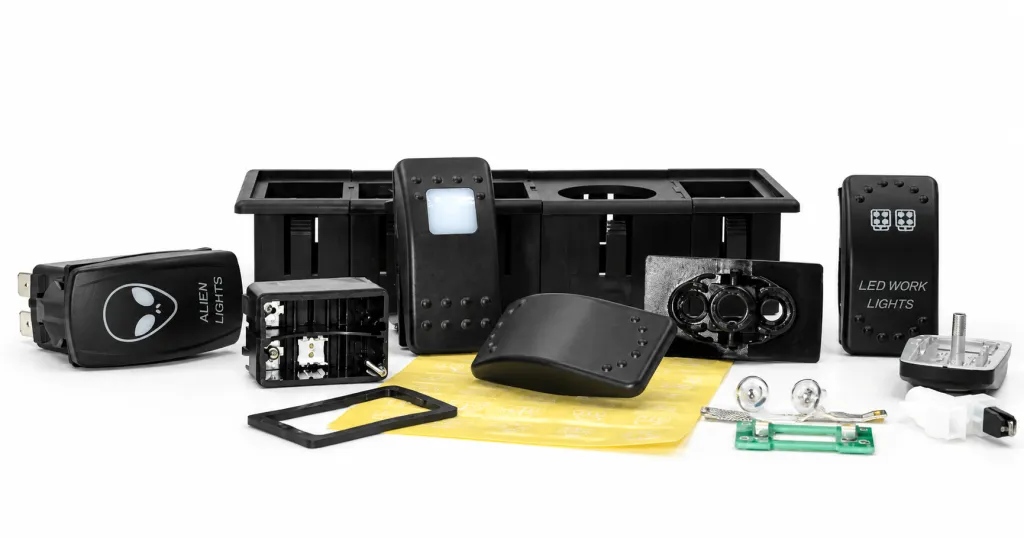
Two rocker switches can look identical, carry the same 20A marking, fit the same 21.2 × 37.2 mm cut-out, and behave completely differently after two years on a boat. The difference is not the rating on the label. It is what happens inside the switch, every time it is operated, at the point where the circuit breaks.
Contact material is the least visible specification on a switch and the one that decides most field outcomes. This guide is about what that choice delivers — in service life, safety, and warranty cost — rather than a chemistry lesson.
What Does a Cheap Switch Really Cost?
For a panel builder or distributor, a switch is a low-value BOM line. That is exactly why failures are expensive out of proportion to part price.
A failed rocker switch produces some combination of:
- A warranty claim — often on a finished panel or a finished boat, not on the switch
- A diagnosis visit — someone has to trace the fault to a component that costs a dollar
- A safety event — the damaging failure mode is not a switch that stops working, but one that will not turn off
- A damaged reputation — the end user remembers the panel, not which component failed
None of these costs scale with the price of the switch. They scale with failure rate. Material specification is how failure rate is controlled, and it is the difference between a switch that is cheap and a switch that is inexpensive.
What Does DC Switching Do to Contacts?
Every switch has two internal contacts that touch to close the circuit and separate to open it. In a DC circuit, opening that gap produces an arc that does not self-extinguish. Unlike AC, where voltage crosses zero twice per cycle and starves the arc, DC current flows one way continuously and sustains the arc until the gap widens enough to break it.
That arc does three things on every operation:
- Erodes the contact surface — metal is vaporised and carried away
- Transfers material unevenly — one contact loses metal, the other gains a spike
- Heats the contact locally — and heat is what causes softening
Soft contacts under an arc can weld together. When that happens the switch stays on regardless of the actuator position. On a pump, a winch, or a lighting circuit, a switch that cannot be turned off is the most serious failure a rocker switch can produce.
The severity scales with the load. Motors and pumps draw inrush current several times their running current, so the arc on make and break is correspondingly larger. This is why the same switch handles a lamp indefinitely and a pump for far fewer cycles.
Every benefit below follows from resisting this sequence.
What Do Our Material Choices Deliver?
Contacts That Release Every Time
The switch contacts are silver tin oxide (AgSnO₂) — a silver-based composite material of the kind used in relays, contactors, and industrial switching devices, selected specifically because it resists welding.
The practical benefit is unambiguous: the switch turns off when it is told to. Inductive loads arc hardest at the instant of break, which is precisely when contacts are most likely to stick. AgSnO₂ is chosen for that moment. For a panel that controls pumps, blowers, or any inductive equipment, this is the property that matters more than any other on the datasheet.
Contact Life That Matches the Duty
Because the contact surface resists arc erosion, the material removed per operation stays low, and the switch holds its electrical characteristics through repeated cycling instead of drifting toward higher resistance and warmer running.
The benefit shows up as predictable service life rather than a product that either works or does not. Panels that cycle daily — a charter boat, a liveaboard RV, a fleet vehicle — accumulate a lot of operations. A contact that gives up metal slowly keeps the circuit stable across that duty.
Terminals That Stay Cool at the Joint
The 6.3 mm (1/4″) terminals are silver-plated copper. Silver plating is specified for the connection point, and its benefit is that it does not form a resistive oxide layer the way bare copper does. A joint that stays low-resistance stays cool.
This matters because a warm terminal is a self-worsening condition: heat accelerates oxidation, oxidation raises resistance, resistance raises heat. Silver-plated terminals interrupt that cycle, which is why the wire joint is rarely the failure point on a properly crimped switch.
A Housing That Keeps Everything Aligned
The base — the part that holds the contacts in position — is a flame-retardant PBT/PC alloy. Two benefits follow.
First, dimensional stability under heat. A base that softens lets contacts drift out of alignment, which accelerates wear no matter how good the contact material is. The base has to hold its geometry at the temperatures an arcing switch generates.
Second, flame retardancy. An electrical component inside a panel is expected to resist ignition, and this is a specifier requirement in marine and vehicle installations rather than a nice-to-have.
The cover is built in layers for the same reason the base is specified carefully: a PC inner cover sits close to the switching mechanism where heat and dimensional stability matter, and an ABS outer cover forms the external surface where finish, colour, and moulding quality matter. Separating the two means neither has to compromise for the other.
Sealing That Matches the Environment
Standard protection is IP66 — dust-tight and resistant to powerful water jets, which covers washdown and heavy spray in exposed panel locations. Where the installation demands temporary immersion protection, IP67 is available on custom order, and the metal push-button switch range carries IP67 as standard.
The benefit is that the sealing level can be matched to the environment rather than over- or under-specified, and mixed panels can use the right component for each location.
What Does This Mean in Service?
Put together, these choices produce a switch that behaves predictably in the conditions marine and RV electrical systems actually present:
- Salt air and washdown do not reach the contacts, because the sealing level is specified for the location
- Vibration does not loosen the internal geometry, because the base holds alignment
- Repeated cycling does not progressively degrade the circuit, because the contact surface resists erosion
- Inductive loads do not produce a switch that cannot be turned off, because the contact material resists welding
- The wire joint does not become the weak point, because the terminal plating resists oxidation
For a distributor, that translates into fewer returns. For a panel builder, fewer warranty call-outs on finished equipment. For an OEM programme, a component that supports the brand promise instead of quietly undermining it.
How Do You Match Contact Choice to the Load?
None of this replaces correct sizing, and it is worth being precise about where material benefit ends.
A 20A switch with excellent contacts is still a 20A switch. A pump drawing 30–40A inrush will damage a contact of this size in direct switching duty regardless of composition. The standard architecture for significant inductive loads is the switch energising a relay, with the relay carrying the motor current. In that arrangement the switch performs a control duty, and good contact material is what makes that control duty reliable over thousands of cycles.
For battery isolation, pole count matters more than anything else — both conductors need to break together, which is a dual-pole function and cannot be substituted with a higher amperage single-pole switch.
Material specification raises the ceiling on reliability. It does not raise the current rating.
FAQ
What are the switch contacts made from? Silver tin oxide (AgSnO₂), a silver-based composite used widely in relays and contactors because it resists arc erosion and contact welding under DC switching.
What is the benefit of AgSnO₂ over a basic silver-plated contact? It resists welding at the moment of break, so the switch reliably turns off even when controlling inductive loads such as pumps and blowers. It also erodes more slowly, which extends electrical life.
Are the terminals made from the same material? No. Terminals are silver-plated copper, 6.3 mm (1/4″). The plating keeps the wire joint low-resistance and cool; it is a connection specification, separate from the switching contacts.
What is the standard IP rating? IP66 — dust-tight and protected against powerful water jets. IP67 is available on custom order, and the metal push-button switch range carries IP67 as standard.
What housing materials are used? A flame-retardant PBT/PC alloy base, a PC body frame and inner cover, and an ABS outer cover.
Can these switches control a bilge pump directly? Only where the pump inrush current falls within the switch rating. For most pumps a relay should carry the motor current, with the switch controlling the relay.
What is the electrical life? 10,000 cycles per circuit, with a mechanical endurance of 50,000 cycles minimum.
—
Related products from Keto Marine
Parts matched to the specifications discussed in this article, available for OEM and volume orders:


